Ghosts and Pubs
Mom and the ghost
Mom used to have about three jobs at any one time, mainly cleaning jobs but occasionally some office admin work. She needed to do this in order to make ends meet. Typically, there would be one or two daytime jobs and then an evening job cleaning the offices at Carter Refrigeration in Tyseley. Her sidekick at Carters was a younger woman called Maureen. Mom always drank tea, but Maureen only drank coffee, so Mom would make up a flask of each and take them to work in her shopping bag. She would make the coffee in a great big jug and there would always be about three quarters of a pint left over, so she’d give this to me to drink as she left home at around 6PM to walk to Tyseley. Cynthia and Ian would normally be out with their mates, so I’d be at home alone, aged 13 or 14, watching TV and getting completely wired on caffeine! Anyway, I digress, that little tale has got nothing to do with the ghost, so here goes…
One of Mom’s daytime customers was a lady called Irene who owned a big, rambling Victorian house in South Yardley. Mom had often said to me that parts of the house always felt cold, even on a warm summer’s day. Then, one day, the two women were chatting in the kitchen when the room went cold and Irene suddenly lurched forward as if she’d been pushed from behind, spun around and exclaimed to thin air:
“LOOK, I’ve told you about this before! There’s absolutely NO NEED to be like this all the bloody time. Have I ever been anything other than kind to you? We both have to live here, so why not just accept it? You really are a stroppy bitch!
Sorry, Elsie, it’s that bloody ghost again. I don’t know why she has to be so rude, shoving me like that, it’s like an electric shock down your back”.
The room got warmer again.
Mom wasn’t fazed by this, she was a very stoic person, took it all in her stride and told me that subsequently sometimes, when the room she was cleaning would go cold, she’d say hello to the ghost in order to stay on her good side and not get pushed in the back!
Eldred, the Flying Monk
One of Ian’s cycling club colleagues was known as Eldred. Apparently, it was his middle name, so naturally the lads at the club preferred it to his proper name, which was Mike or something like that. He was older than the other lads, about 30, a truck driver and married with two kids. When we went to a race meeting somewhere in the country, Eldred’s road knowledge would be invaluable, if there was a traffic hold-up, he would always know an alternative route.
Eldred had a bald spot on the top of his head, crown balding, so that quite naturally led to him being nicknamed ‘the monk’ and his frantic cycling style rapidly led to that becoming ‘the flying monk’.
He was a bit of a maniac on the bike, with no sense of moderation or tactical know-how, he’d just go flat out and hope for the best. One circuit road race in South Wales was a typical example. All the way to Wales, the lads were telling him to take it steady at the start, learn the course, work out the best plan of action and then use his natural speed and ability at the most opportune moment. He listened carefully, nodded his agreement and vowed to take their advice on board.
We all gathered halfway around the circuit, which was about five miles, waiting to see how Eldred’s category race was developing. The riders duly appeared, with the flying monk about 200 yards in front of everyone else, eyes bulging and shouting “They’re fuckin’ shit, these Taffies! I’m gonna win this race dead easy!”
The riders came around for the second lap, with Eldred about 50 yards off the back. They’d encountered the first steep hill of the course, attacked as a group, overtaken him and left him for dead. Somewhat inevitably, he finished in last place, miles behind everyone else.
Eldred eventually dropped out of the cycling team and the next time I saw him would have been about ten years later on the Tilton Road End at Birmingham City’s St Andrews stadium. He’d got involved with some of the football hooligans and had ‘BLUES’ tattooed across his forehead in inch-high block capital blue letters. Let us not forget that this was a man married with two kids, holding down a full-time job, but behaving like a rather immature teenage yob.
Black Velvet Band
Small Heath had a large Irish population. As a 14 or 15-year-old, I used to go with the next-door neighbours to the Irish Community Centre in Digbeth on a Saturday night. There would always be what I believe is referred to as a ‘good craic’ there. I’m of Irish descent with an Irish surname, so was acceptable to the doormen, albeit after some negotiation. They’d have some good artists playing there, bands like The Dubliners, but there would often be some unpleasant IRA-supporting types in there as well, extorting money out of the generally good-natured clientele for ‘the cause’.
I became a bit of an authority on Irish rebel songs such as ‘The Foggy Dew’, ‘The Boys of the Old Brigade’ and, of course ‘The Black Velvet Band’
One time, I was in there with my next-door neighbour, John Cronin, who would have been about 13 at the time. We were just about to lift a pint to our lips when the manager came scuttling over: “Gimme dem drinks, lads! Yer mustn’t be seen to be drinking in here tonoight. See dem two fellers over dere by the bar? They’re plain clothes coppers, dey are. Stupid feckers think we don’t don’t know, but dey stick out by a moile. Get yerselves a shandy” And, with that, he confiscated our pints. The following week when we went back to the club he treated us each to a couple of pints ‘on the house’, by way of apology.
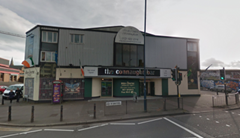
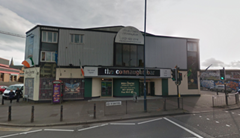
The Irish Community Centre, Digbeth, after it had been rebranded as The Connaught. (c) iambirmingham.co.uk
Shard End
When Ian and Lynda first got married, they rented a grotty, damp, cramped, condemned terraced house in Hay Mills. Fairly soon, though, they scraped together the money for the deposit on a decent semi-detached house on Brownfield Road, Shard End. It was a self-build house, one of several in a row and the overall impression was that the amateur builders had run out of enthusiasm before the job was quite finished and rushed the finishing touches. Nevertheless, though, it was a pretty decent house that just needed sprucing up a bit. Ian set to work and I was recruited as his willing assistant and general dogsbody. For me, the highlight was when he equipped me with a sledgehammer and turned me loose on a garden wall with trellis that Lynda wanted knocking down. For a 15-year-old lad, being employed on an orgy of wilful destruction like this was indeed a dream come true! We used all the rubble as hardcore for a greenhouse at the bottom of the garden.
Lynda has a brother called Eric. We held Eric’s 21st birthday party at the Shard End house. A very good friend of ours was a DJ called Bob King, well-known on the Birmingham circuit and one of the resident DJs at Rebecca’s and Barbarella’s clubs in the city centre. Bob agreed to play at Eric’s party, so wheeled his enormous sound system into the three-bedroom suburban semi. My gaggle of school friends and I arrived in Shard End on the No. 55 bus, just as Bob was setting up. We alighted the bus at Shard End Crescent, which is about half a mile away from the house and could hear every note, as if we were standing next to the speaker bank. Amazingly, no neighbours complained about the noise.
The party got underway and various posses began to arrive. Eric and his girlfriend Maxime were regulars at a pub called the Selly Park Tavern, which is a short walk from Edgbaston Cricket Ground. Upstairs at the Selly Park there used to be a little jazz club, featuring an amazingly talented drummer called Tommy Webster, who, so the legend went, had deputised for Buddy Rich on occasion. The jazz club was popular with visiting thespians working at the Birmingham Rep. The Selly Park Tavern was what I like to call a proper ‘drinkers’ pub.
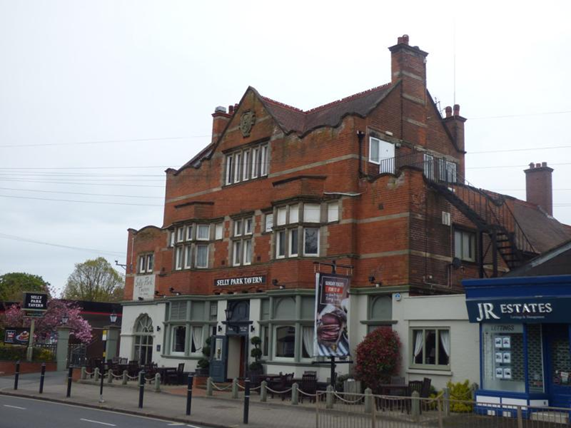
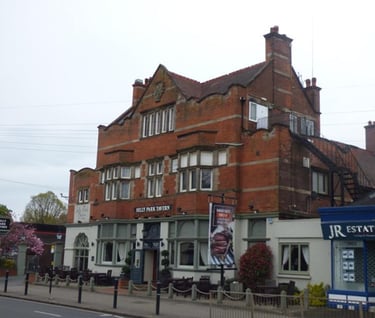
The Selly Park Tavern © Publocation.uk
On the night of Eric’s party, the Selly Park mob turned up with the great character actor Freddie Jones in tow. Freddie was, shall we say, a little the worse for wear and was wearing a rather spectacular pink felt fedora hat. At some point during proceedings, Freddie and I found ourselves sitting on the front wall, both drunk (I was about 15 at the time) and letting our ears recover from the deafening noise of Bob King’s disco.
Freddie had lost his pink hat. He was distraught and lapsing into full Shakespearean stage mode:
“Colin, dear boy, I have lost my hat. You know, that blessed hat meant EVERYTHING to me! I would give my right arm, nay MY VERY LIFE INDEED, to get my TREASURED hat back. That hat is indeed my WORLD!”
As the final words left his lips, the hat magically appeared over his shoulder, borne on the extended hand of one of my schoolfriends who’d been wearing it.
The evening progressed; I carried on with my underage drinking blitz and, eventually must have passed out on the landing. I awoke to find myself in complete darkness, underneath a rough surface of some kind. I was terrified, thinking I’d been buried alive somewhere. Eventually it transpired that someone has noticed me unconscious, told my mom who elected that the kindest thing to do would be to leave me be and cover me with a rug to keep me warm.
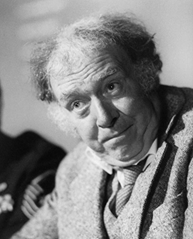
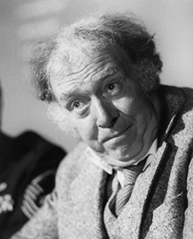
Freddie Jones, great character actor and thoroughly likeable drinking companion (c) Unifrance
I’m sorry, I didn’t recognise you with your clothes on
When I was about 17 or 18, there was a party at Toff’s house. It was the usual teenage affair – loud music, people smoking grass and drinking too much. I got tired and went for a kip in Toff’s parents’ bed (as you do). The door opened and this girl came into the bedroom and clambered in alongside me. We’d seen each other downstairs but hadn’t really spoken much, if at all. She said her name was Jackie.
A couple of weeks later, I was waiting for the No. 28 bus at the Fox and Goose when a girl appeared, wearing the uniform of Washwood Heath Comprehensive School. At first, I didn’t recognise her, but then she said, “It’s me, Jackie from the party”. For the first and only time in my life, I was able to use the corny old comedians’ phrase “Sorry, I didn’t recognise you with your clothes on!”
I said “Hang on a minute, you told me you were 18”
“Yeah, well I was lying, wasn’t I?”
This kind of thing all seemed perfectly normal in 1970s Birmingham.
Yates’s wine lodge
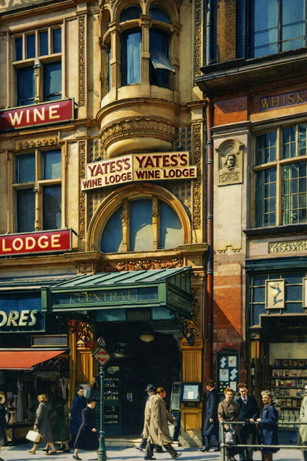
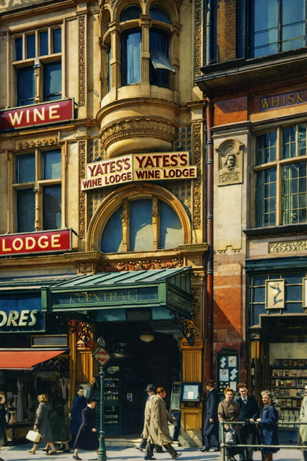
Yates’s Wine Lodge in the 1950s courtesy Mirza Zahid Hussain. It hadn’t changed much by the 1970s
One of the popular places we used to visit on a Friday or Saturday evening was Yates’s Wine Lodge on Corporation Street. Yates’s was not dissimilar to the Mos Eisley Cantina bar in Star Wars with its wild mix of aliens, only the aliens at Yates’s were more unusual. They used to sell really cheap spirits and dog-rough Australian Sherry whilst employing a queuing system whereby you’d buy a drink at the bar, shuffle in a clockwise direction along to the end of the bar and then join the queue of people behind a rail that ran parallel to the bar, shuffle along and eventually rejoin the line of people being served at the bar. Drinkers would do this for hours, barely speaking to anyone, just shuffling around in a circle and drinking nasty cheap spirits or sherry.
Around the perimeter of the Yates’s bar were simple wooden chairs with old, beer-stained tables. Many of these chairs would be populated by wizened and haggard old prostitutes who were generally quite a laugh. We’d buy them a sherry and have a chat with them.
The Shakespeare
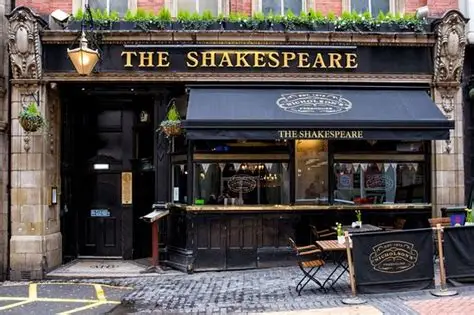
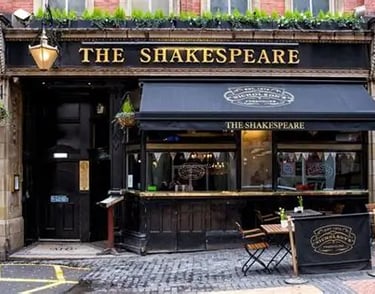
The Shakespeare © Tripadvisor
Rather than the trendy pubs and clubs, geared to attracting teenagers and students, we used to prefer drinking in the ‘proper’ old-school city centre pubs, one of which was the Shakespeare. One night, I was minding my own business, having a quiet wee in the gents’ when suddenly the door burst open and dozens of blokes came charging in, started flushing things down the toilets and throwing packets of stuff out of the little window.
The Drug Squad were raiding the pub.
I made my way out of the loo, through the throng of panicking dealers and sauntered over to stand by the juke box, where I’d left my drink on top. A uniformed policeman eyeballed me and started to make his way over. I was 17 and drinking underage, so fully expected to be nicked and charged. Steelhouse Lane cells were undoubtedly waiting for me. The Custodian of the Law approached and said:
“Sorry, mate, but I’m bloody parched. Could I have a sip of your beer?”
I was in no position to refuse.
Chicago
I would have been about 18 or 19 and had been smoking dope with a friend in Bordesley Green. It was pouring down with rain, and I was walking back to Small Heath, wearing my Women’s Army Corps greatcoat and sporting bedraggled shoulder-length hair. It was a pretty miserable night, so I elected to entertain myself by singing ‘My kind of town, Chi-ca-go is’ and stamping in puddles to accentuate each syllable.
I became aware of a tall presence alongside me. It was a policeman wearing a cape, with his hat pulled down tight to try and stop the rain from running down his neck. If you’re familiar with the classic Morecambe and Wise ‘Singing in the rain’ sketch, you’ll get the general idea of what this little tableau looked like. I was mortified; I had a few ounces of prime Afghan Black in the lining of my greatcoat – enough in those days to find yourself potentially facing a 5-year prison sentence. The constable spoke:
“Had a few, have you, son?”
“Erm, yes, officer. I’m heading for home”
“That sounds like a good idea. I’d do the same if I had the opportunity. Go home and get some sleep, looks like you need it. Drink some water before you go to bed, you’ll feel the benefit in the morning”.
“Quite right, officer, thank you very much, officer”
“Goodnight”
“Goodnight”
One of many lucky escapes I had.
On Boutique Duty
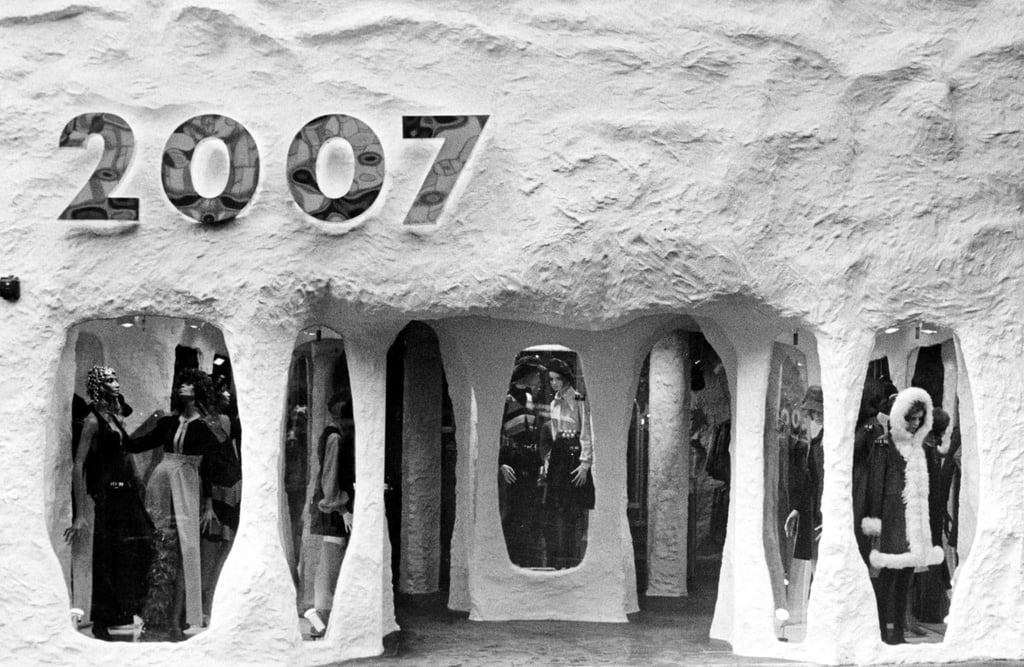
2007 Boutique © Onceuponatimeinthe70s.com
There were a couple of popular boutiques with teenage girls in Birmingham in the early 70s, one was the futuristic 2007, the other was Chelsea Girl. Janice, my girlfriend, would enjoy browsing in both of them, so on many a Saturday afternoon I would duly find myself hanging around outside with a few other bored blokes, for what seemed like an eternity. At periodic intervals, one of our partners would emerge, having bought nothing and the victim would loyally move along to the next non-shopping venue.
Later in the 70s, in the punk and New Romantic era, there was a very trendy clothes shop called Kahn and Bell in Hurst Street. I had a lodger at the time who was very heavily into that scene, so the whole situation would sometimes repeat itself if we were en route for a pizza somewhere and she absolutely HAD to go in for a browse around. She was a student, so could never afford to actually buy anything there, but it was important to be seen.
She could never afford to pay for her pizza, either, which I believe is why she put up with having me hanging around.
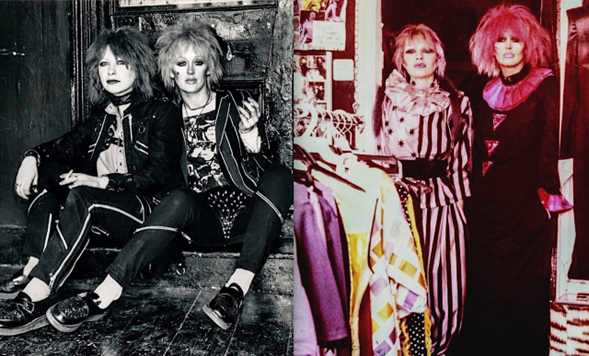
Patti Bell and Jane Kahn © Shapersofthe80s.com
On the buses
I used to travel everywhere by bus or taxi; in fact, I didn’t learn to drive until I was in my mid-20s and only then because I needed a driving license for work purposes. The buses were quite often a source of entertainment and a few incidents spring to mind:
There was a Jamaican bus conductress who was being racially abused by a nasty Irish woman. The Irish woman told her to ‘go back to where she came from’, at which point, the conductress rummaged in that little leather satchel that they used to keep the small change in, where, for some unknown reason, she had her old British passport. She waved the passport in the face of the Irish woman and simply said “Darlin’, have you got one of these? No – thought not. Now, why don’t you go back to where YOU came from?”
Another time, I had just got to the top of the stairs on a bus and suddenly found myself flying back down the stairs as a voice shouted “Colin, Man! How ya doin’?” It was a West Indian friend of mine who was a boxer. He’d seen me, but I hadn’t seen him. He’d greeted me with a friendly punch on the shoulder, caught me off balance and the force of an affable blow from a trained boxer had knocked me clean off my feet.
The third incident wasn’t so pleasant. I would regularly catch the night buses and would often see the same people on them. There was one regular, a young chap who was disabled, with deformed legs, he could barely walk and then only with two walking sticks. One night he was on the bus and was being very rowdy, so the bus driver stopped outside Hay Mills Police Station. The police came on board, dragged him off, and the last I saw they were kicking and clubbing him all the way down the corridor to the cells.
The Greyhound
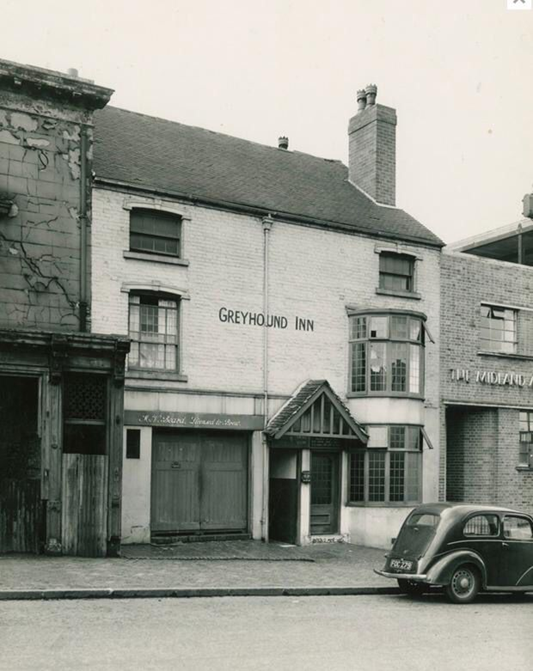
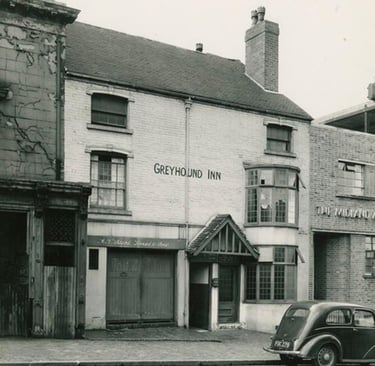
The Greyhound Cider House
There was this pub called The Greyhound on Holloway Head. They only served cider and the place was rough. Dead rough. In fact, they used to serve a cider called ‘The Rough’, which was pretty much guaranteed to give you Diarrhoea. It only cost pennies, so naturally we would drink it and endure the inevitable consequences. It was fairly commonplace to see people lying unconscious on the pavement outside. The local chapter of the Hells Angels used to meet there on a Thursday. It was perfectly safe to drink in there, though, just as long as you didn’t look at anybody…
Birmingham Pub Bombings
November 1974. It was a Thursday night, a night when the pubs would be particularly busy because traditionally in the hundreds of factories around Birmingham, Thursday was pay day. Most Thursdays, Janice and I used to meet up with a friend from Oldbury in the city centre. We’d meet in a pub called the Mulberry Bush, because it was next door to New Street Station (he came in on the train), have a couple there and then relocate to somewhere like The Windsor, The Shakespeare or the Midland Hotel. On the evening of 21st November, he called Janice’s house to say he couldn’t make it, so Janice and I decided not to bother going into Town and have a drink at a pub called The Moonraker in Acocks Green, close to where she lived.
At about 9 o’clock, we heard the sound of ambulances and fire engines racing down the Warwick Road and more distantly on Coventry Road. Very quickly, we learned that IRA bombs had gone off in the city centre, although at this point, we didn’t know where exactly. There was an eerie atmosphere in The Moonraker. People looking silently into their beers, not talking much.
I walked home to Small Heath (the roads were in chaos), to find Mom still up. She knew by then that the Mulberry Bush had been hit and also knew that we used to go there. We didn’t have a phone in the house, so she was completely isolated and frantic with worry. In reality, had we been in town that night, we would most likely have moved on from the Mulberry Bush by the time the bomb had gone on in there, but of course she didn’t know that at the time.
Ten people were killed in the Mulberry Bush, dozens were injured, many of whom who had limbs blown off. Quite a few people we knew by sight. The nearby Tavern in the Town pub was also bombed; in total 21 people were killed and 182 injured. A third bomb, on Hagley Road, failed to detonate. For a long time, this was the biggest mass murder in British history.
A few friends of mine, decent people from the Irish Community Centre and the Emerald Club by the Blues ground were in town that night. They made a beeline for Steelhouse Lane police station and told the desk sergeant that they had names of people that the police should pull in. Amongst the names they gave the police were the men who, wrongly convicted, were later to become known as ‘the Birmingham Six’. They were known fund-raisers for the IRA and weren’t generally liked amongst the Irish Community in Birmingham. They eventually spent 16 years in prison for something they hadn’t done.
The atmosphere in Birmingham for the next few days was febrile. Several Irish pubs and clubs were attacked, and police protection was required for Catholic churches in some areas. Many Irish people at the factory where I worked were too frightened to come into work and stories were told about IRA-supporting men being beaten up in other factories. Harry, mom’s boyfriend, told me that at Fort Dunlop where he worked, Management had to intervene to save one man from being forced into a razor-sharp rubber shredding machine. It took several weeks for things to calm down.
The Rum Runner and the Tow Rope
A friend of mine had a girlfriend who was bar manager at a club on Broad Street called the Rum Runner, which had become extremely fashionable amongst the New Romantic crowd and attracted visitors from all over the country. The friend used to work in a recording studio called Nest, which was underneath a music shop called Wasp on Holloway Head. Sometimes we’d mess about in the studio, mixing and remixing tracks that had been recorded during the week and then, at about 1:00 in the morning, swan over to the Rum Runner, get free admission and have a couple of free drinks.
For one of a delicate disposition such as myself, the Rum Runner was quite a daunting place. They had seating around the edges of the club contained in big ‘rum’ barrels and some of the things that went on in those barrels were really not suitable for public consumption
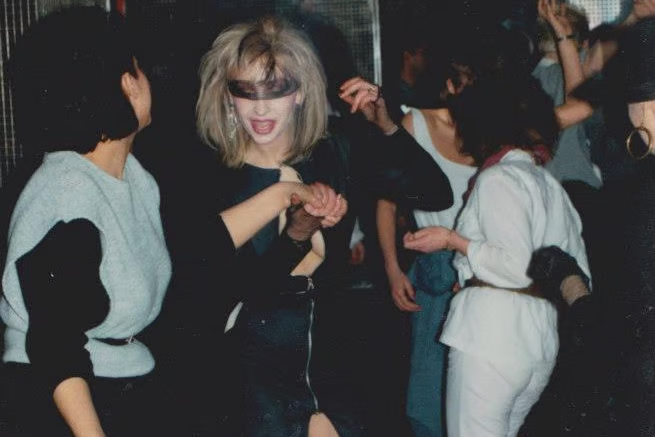
Inmates of the Rum Runner © Birminghamworld.uk
There was this group of young local kids called Duran Duran, who based themselves as the Rum Runner and worked there, collecting glasses, minding the doors – that kind of thing. They played there occasionally. I don’t know whatever became of them.
At chucking out time, we would decamp to a all-night café directly opposite the club called the Tow Rope, which was open all night. The lads from Duran Duran would sometimes come along and, or so I’m told, a young kid called George O’Dowd, who I must stress I didn’t know, would also be there. He worked at the Oasis clothes market and later reinvent himself as Boy George. There would occasionally be small fights and scuffles breaking out in the Tow Rope, but they would usually be quickly snuffed out by the manager, whose name I think was Tony or Barry. It was actually normally quite a peaceful place, full of amiable drunks, munching quietly on a sausage sandwich before going home in the daylight.
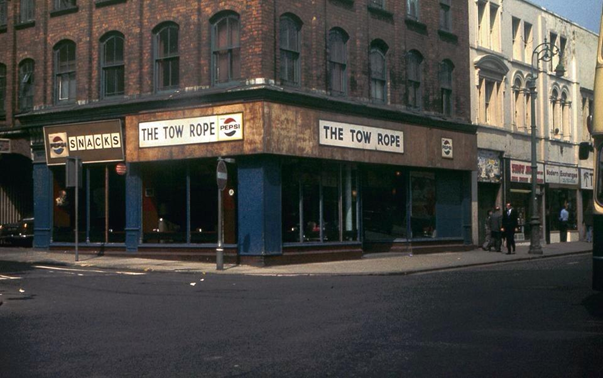
The Tow Rope, Broad Street
The Rangoon-A-Go-Go
After I’d left Small Heath and struck out on my own, living in Stechford and then Hodge Hill, I used to go back to visit my mom, who was still in Monica Road. Going ‘home’ for Christmas Day lunch was always a fixture in the calendar, and our local pub, The Monica, would have a lunchtime disco where Janice and I would get to catch up with various other former Small Heath types who’d also left the area. By now, Small Heath was morphing from being a primarily Irish/Polish area into more of an Asian area, so the lunchtime disco would incorporate people of various heritages, bopping away together quite amicably. The Muslim lads didn’t make a big deal of Christmas but celebrated it with us by partaking in a decent drinking session, accompanied by a lot of wild dancing. We nicknamed it the ‘Rangoon-A-Go-Go’
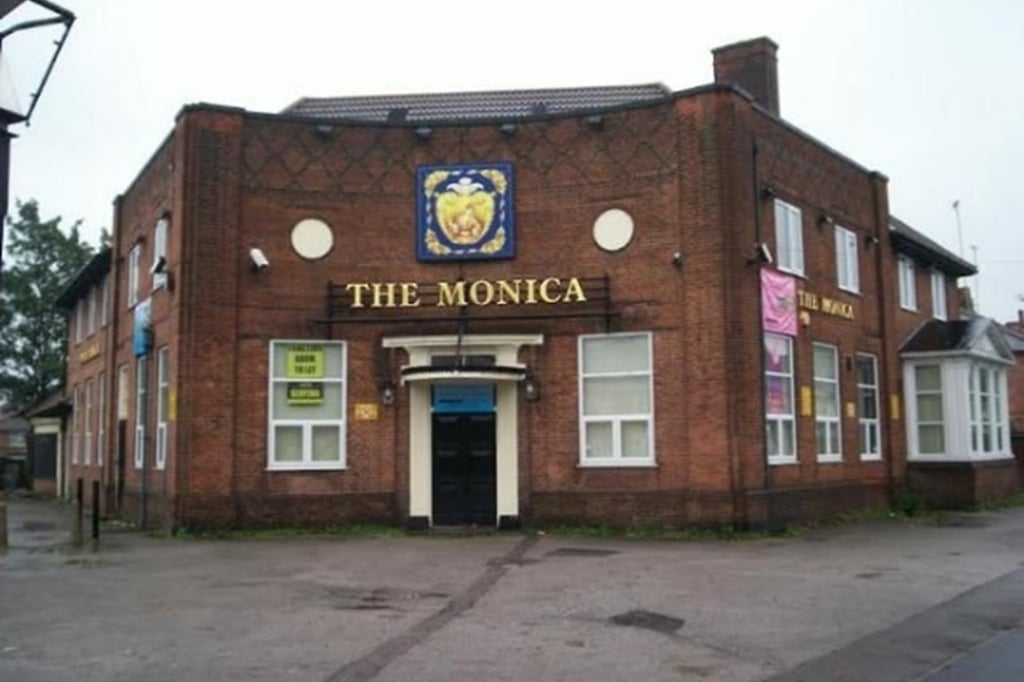
The Monica Pub picture courtesy of Abz Hussein
And so, my teenage years drew to a close. Birmingham and Small Heath were changing. No better, no worse, just different. Life moves on, people come and go, cultures shift, but underneath it all, most people are much the same. It grieves me when outsiders try to cause division. In my lived experience, the vast majority of people just want to get along together. There’s good and bad in all communities, so live and let live, even if it means being like Irene and sharing your home with a stroppy ghost!
I hope you found all of this at least remotely interesting! It would be great if you could buy me a coffee to help towards the production, hosting etc. costs!