Me and Phyllis
Phyllis and I never actually met, but it seems quite possible that our paths crossed sometime in 1957. She was 48 at the time and I was 2, so I doubt we would have had all that much in common, and it was certainly no basis for any kind of long-term relationship, but then again, you never know…
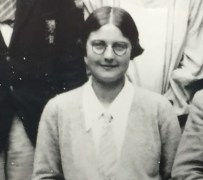
Allow me to elaborate: Birmingham University has a fascinating collection of photographs by Phyllis Nicklin, a university lecturer whose meticulous photographing of a decaying Birmingham in the 1950s and 1960s has created a remarkable legacy of around 1,000 slides, a great piece of social history. One of these pictures shows the back of our house. I would have been asleep at the time, in the back bedroom of the terraced house at 47 Waterworks Street, Aston. As far as I’m aware there were no actual waterworks in Waterworks Street, although there was a reservoir very nearby in Salford Park, so maybe there had been a waterworks in the area at some time or other. Phyllis took a photo from the top of the flats in Salford Park:
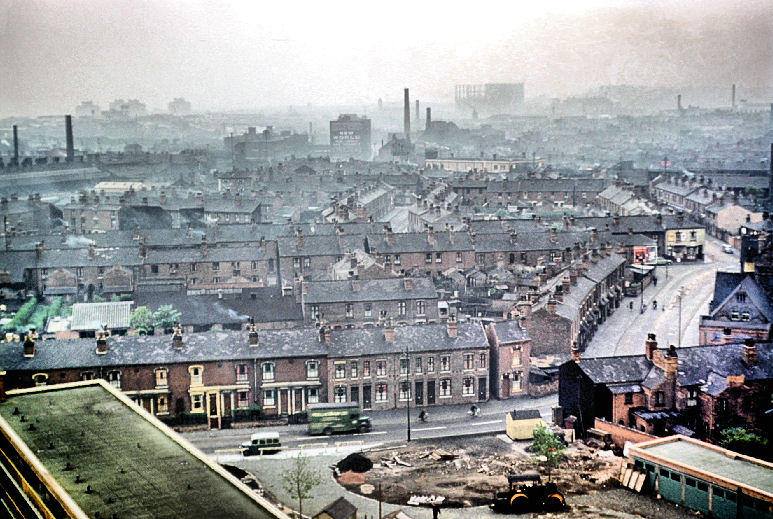
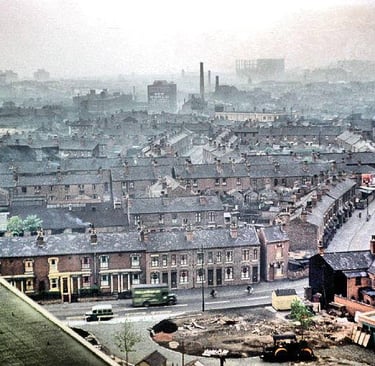
Aston, 1957 - View east from top flat of Salford flats by Phyllis Nicklin, used under CC BY-NC-SA. © University of Birmingham
On Phyllis’ photograph, the third row of houses you can see is the rear of Waterworks Street (incidentally, note how litter-free and tidy all the streets are). Our house was a two-up, two-down, we three kids were stored in the back bedroom, mom and dad had the front one. Since I would have been two at the time of the photo, Ian and Cynthia, my brother and sister, would have been at school, so there’s a fair chance I may have been asleep now that the house was finally quiet! The large rectangular building in the top centre is the HP Sauce factory, Ansells Brewery is to its right, to its left you will see a small steel rolling mill and at the top of the picture, the gasometers at Aston Gasworks. Imagine, if you will, the aromatic ambience; with the vinegary, spicy smells of the sauce cooking at HP, the hops fermenting and brewing at Ansells, the hot steel fumes from the mill, the smoke from the innumerable coal fires in the terraced houses, the faint whiff of gas from the gasworks and, if the wind was in the right direction, the unmistakable acrid scent of the nearby Saltley coke works.
This evocative photograph opens up a whole new world of reminiscences.
Life in Aston
I was born in 1955 in the grim slums of Aston, Birmingham, at this very house, about 800 yards from Villa Park. I was the third child of two as my mother was to explain to me when I’d achieved adulthood. Apparently, mom and dad had only ever wanted the two kids, Ian and Cynthia, but then, completely out of the blue, I popped up, as mom was later to tell me, “courtesy of the London Rubber Company Quality Control Department”. Not exactly planned, but loved nonetheless, as she was at pains to point out. Mom, who was 35 at the time, had a gruelling time giving birth to me, I was quite a vast baby, weighing in at over ten pounds and mom was only a small woman. She was in labour for two days, far longer than she’d been for the other two. Dad was in tears, he thought she would die. In those days, most women had their babies at home with several neighbours in attendance, and I was no exception, so all mom had was their kindness, company and attention whilst she suffered through it all, I suppose nowadays for a hospital birth, she’d probably have had a caesarean if the labour was as difficult as mine had been. Anyway, eventually I slipped out into the world and, to be frank, have been a bit of a nuisance ever since…
We lived in one of those very close-knit working-class communities, so familiar to anyone growing up in Birmingham, Liverpool, Manchester, Glasgow, Belfast, Newcastle, Cardiff and heaven knows how many other downtrodden regional towns and cities of Industrial Britain. My Nan and Grandad lived just around the corner in Sutherland Street, a few doors up from them were my Uncle Tom and Aunty Doris, a couple of doors down from our house were Aunty Alice and Uncle Bill. As well as these genuine kinfolks, half the neighbours were also referred to as Uncle or Aunty, although they were not related in any way, shape or form. We kids never knew who our actual families were, but the community spirit between all these disparate but linked households was remarkable, especially in times of crisis when everyone would chip in to help each other out. An example of the kindness of the local people would have been before my time, when my mom was a little girl in the 1930s; my grandad had caught glandular fever and was unable to work for a while, so there was absolutely no money coming into the house to feed his wife and three kids. The neighbours, totally unprompted, got together, organised a rota and at each mealtime one of them would put up an extra meal for the family, then deliver it steaming hot with a tea towel over the top of the dish it had been served up in. Nobody expected payment for this, of course, it was just ‘what you did’. Grandad would pretend he wasn’t hungry, insist that the kids got fed first, next his wife and then he’d mop up whatever was left over.
Saturday night bath time was always an event. We had no bathroom or inside toilet—just a tin bath on a nail behind the kitchen door. Mom boiled water in her twin-tub washer, piped it into the bath on the floor, and we commenced. Parents first, then kids by age. As the youngest, I went last.
By then, the water held a week’s detritus from Mom, Dad, and two grubby kids playing in Aston’s streets and bomb sites: lukewarm sludge topped with oily scum, grey suds flecked with mud, and grit at the bottom. The Birmingham and Fazeley Canal was cleaner. Most weeks, I emerged dirtier than I’d entered—but built a robust immune system that serves me still.
The only bit of glamour in Aston
Much of everyday life in Aston revolved around Aston Villa Football Club. In those days, football clubs were very much part of their local community, for example when he was retired, my grandad would often pop down to the local café to sit with the Villa players after they’d finished training. The players would be having a fry-up and a smoke in order to negate any possible beneficial effects of having run endless laps of the pitch under the evil eye of a sergeant major-like trainer in a baggy-arsed tracksuit and a woolly hat. Grandad would have a few cups of tea and talk football with the players. He loved his football and passed the curse down to me.
In 1957 Villa won the FA Cup, unexpectedly beating Manchester United’s fabled and ill-fated ‘Busby Babes’ team, a singular feat achieved in no small part by the cunning tactic of maiming the Manchester United goalkeeper inside the first ten minutes. They brought the cup back to Aston and an open-topped bus made its way through the triumphant, crowded and chaotic streets back to Villa Park. Somewhere in the middle of all this confusion was mom, dad, Ian, Cynthia and, well, everyone else in the neighbourhood. I was two years old, in a pushchair, probably only able to see the backs of thousands of adults’ legs. Somewhere along the route I kicked off one of my little shoes, which absence no-one spotted until we were outside the impressive Trinity Road stand, a masterpiece by the legendary Scottish architect Archibald Leitch. Mom and dad assumed the tiny shoe was lost forever until, on the way home, they spotted it sitting atop some railings with a handwritten note saying ‘It’s Here!’ That’s just the way people were, back in the 1950s. They cared.
Local characters
I suppose all neighbourhoods have their share of interesting characters with back stories, and Waterworks Street was no different. To my shame I forget his surname, but one of our neighbours, a ‘Charlie something’ was once at home when a card popped through the letterbox. It was an invitation to the world premiere of the film Lawrence of Arabia, starring Peter O’Toole. Charlie’s wife was mystified, saying:
“What’s this”
“Oh, it’s just an invitation to a film about Lawrence of Arabia”
“But why on earth have they sent it to YOU?”
“I was with him in the desert. They must have sent one to all of us. I might go along to see all the fellas again, if they’re still alive”
“Eh? what? You never mentioned anything about being in the desert with Lawrence of Arabia”
“Well, you never asked”
“So, hang on a minute. All that cloth you brought back from the War, the cloth I cut up and used for dusters. Was that something to do with all of this?”
“Yes, those were my Bedouin robes. I used to wear them instead of uniform when I was on the camel. It was more comfortable”
“On the CAMEL?????”
…and so it went on.
There was another old chap in the street who was a bit of a local celebrity: They used to hold an annual Nottingham to Birmingham road race. It’s about 55 miles. There would be a cash prize for the winner, so people took it seriously. I think it was something to do with either the Nottingham Goose Fair or the Aston Onion Fair. The chap in question had won the race, at least once, maybe twice, in the 1930s. No-one had proper running gear, so the men would just do it in their everyday work clothes, hobnail boots, long heavy flannel trousers, braces, cotton shirt with the sleeves rolled up. No tie, even though it was a Sunday. Obviously no-one could actually RUN fifty five miles in that kind of clobber, so the race would essentially be 55 miles of brisk walking, interspersed with the occasional short jog. These folk were tough.
Grandad - the link between local history and proper History
Grandad told me that when he was a young boy there was an old man in their street who’d been a drummer boy at the Battle of Waterloo. This kind of thing makes you realise that History is more connected to us than we sometimes think. Grandad had a remarkable memory for detail and would always be good value for a story, for some reason I remember him talking about the Britannia Inn pub on the Lichfield Road. It had a statue of Britannia on the roof which at some time around the turn of the 20th century had required some maintenance. Grandad regaled me with a story of how he’d stood idly by for an afternoon and watched the work being done, particularly impressed by the fact that the stonemason had a big ginger beard and a great sense of balance on the rickety timber scaffolding.
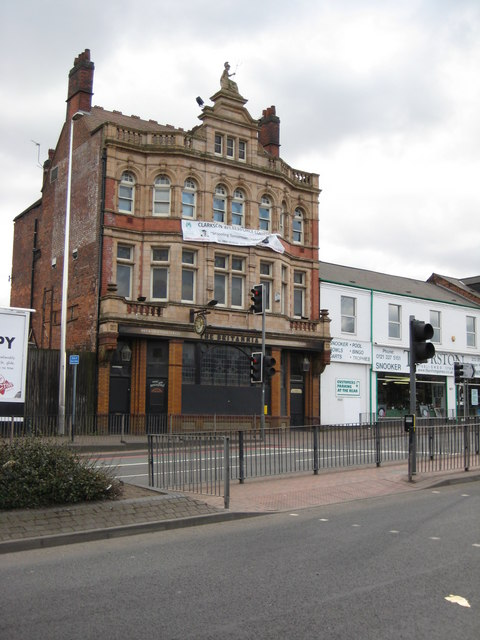
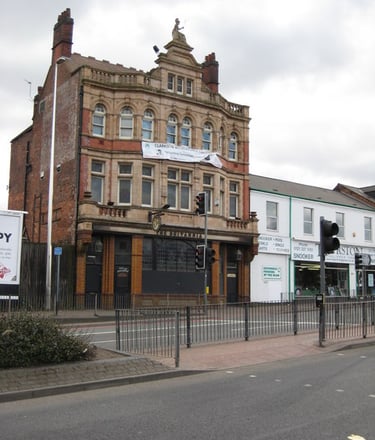
The Britannia Inn, Lichfield Road, Aston. © Phillip Halling.
Directions to get anywhere were fun when given by grandad, it would usually go something along the lines of:
“Go left down this road and then when you get to the Reservoir Tavern, turn left again. Go down there, past the Three Tuns and just before you get to the Prince of Wales turn right. On the next corner you’ll see the Kings Arms (the gaffer there has got a big Alsation dog). Turn left at the Kings Arms and then past the Grapes and the Golden Hind. Next corner is the White Swan, you can only go right there – the car spares place you want is just down that road. I don’t know what the road’s called”
This method of navigation was particularly accurate when you wanted to get from Aston to Small Heath. Although grandad was a mad-keen Villa fan, when Villa was playing away he would walk to St Andrews to watch Birmingham City. He’d call into a few pubs on the way there and on the way back for a half of Mild in each and get a Cheese and Onion Cob at one, for, as the Bible says, Man Cannot Live by Mild Alone. It would be an all-day excursion, the distance isn’t too far, about 4 miles with the requisite pub diversions, but stopping several times for essential refreshment meant that he’d be gone for hours.
Grandad was a lover of silly music hall songs and monologues such as ‘The Lion and Albert’, ‘With Her Head Tucked Underneath Her Arm’, (https://youtu.be/ZRBPr5jbS5M) ‘Your Baby Has Gone Down the Plughole’, ‘I’m One of the Ruins that Cromwell Knocked About a Bit’, ‘The Spaniard who Blighted my Life’ and many, many, more. It was always entertaining to be with him when he was in Entertaining Mode – this was later, when I was about eight, but he would send me off to the Pump Tavern with a quart jug, I’d stretch up to the counter, proffer the jug to the landlord, who would fill it up with Ansells Mild and then I’d carefully totter back around the corner to Sutherland Street, trying not to spill too much and then the show would commence. Interestingly, thinking about it now, most of the old men in those days would drink quarts of beer rather than pints. Grandad told me about his own father who worked in a foundry. The work was back breaking and incredibly hot. This was in the days before Trade Unions, so the men weren’t allowed a break or any refreshments. They typically worked a 12-16 hour shift and toward the end of the shift, grandad’s job would be to go to the pub and ensure that everything was set up – the landlord would fill two quarts of beer for each man, the men would come in from the foundry, parched and filthy, the first quart would be swallowed in one gulp, purely to quench their thirst, nobody would speak, then the second quart could be actually tasted and the men would relax and have a chat. That’s half a gallon of beer just for starters!
Electric Avenue
Most of my family worked at the General Electric Company on the splendidly named Electric Avenue in Witton. My uncle Les (a real uncle) was the Technical Director, uncle Bill (a pretend uncle) was in the drawing office, uncle Honk (real name Albert, but not a proper uncle) was the Works Manager, my dad was the Toolroom Foreman, my mom had worked on the switchgear assembly lines with my aunty Alice and so on. There were dozens of the blighters working at GEC! They used to have a lot of fun there, usually with some kind of stunt being pulled.
One stunt involved Kong: bodybuilder strong as an ox, thick as two short planks. One lunch, as the blokes ate sandwiches round their machines, someone pitched the ultimate strength test: stand in two buckets, lift yourself by the handles.
Galvanised buckets procured, Kong climbed in. For half an hour, they egged him on while munching: “Come on, Kong! I see daylight under the right one! Nearly there, mate!” Red-faced and sweating, he heaved.
My dad fell victim to another GEC stunt – they held a charity raffle for Birmingham Children’s Hospital. The first prize was to be (quote) ‘a splendid clock for your mantelpiece, a real conversation starter’. Dad bought the winning ticket, only to be told that he’d won the clock at Aston Cross, which is about 40 feet high, made of cast iron, concreted into the ground and, oh yes, Grade II listed. He was, however, told that he’d be free to carry it home if he so wished. The ceiling in our living room was only about eight feet high, so he would have had to saw a big piece off the bottom of the clock in order for it to fit on our mantelpiece. Dad decided to err on the side of caution and leave the clock where it was. As dad’s only living descendant, I think legally speaking the clock may still be mine, though.
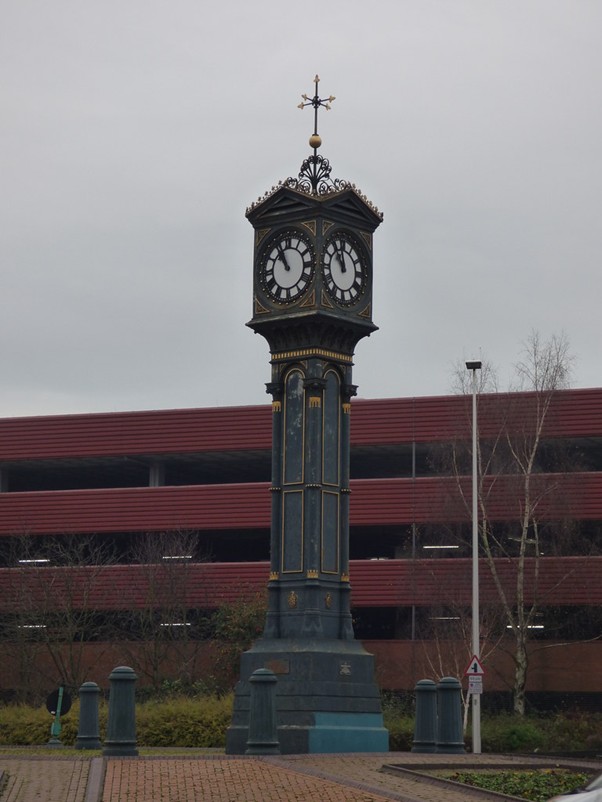
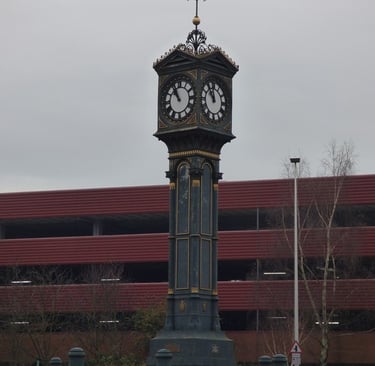
The clock at Aston Cross. Technically, I think it belongs to me.
The story of Fred
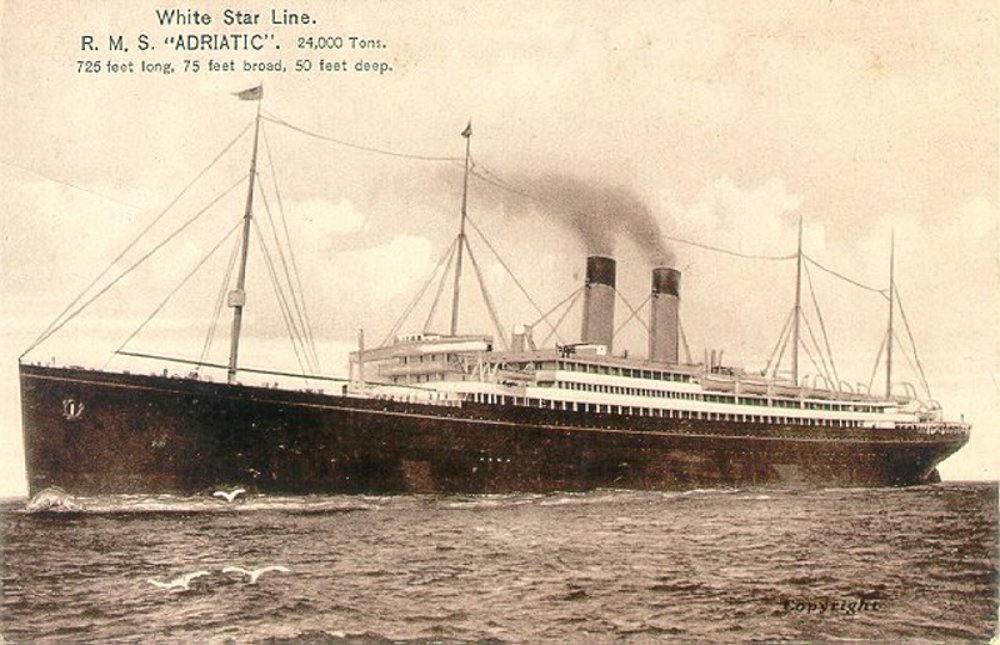
Before he started winning bogus raffles, my dad, Fred Carberry, had led an interesting life. He’d been born in New York City in 1913. His father was an Irish immigrant, Henry Carberry, and his mother an English immigrant, Lilian Grindley. He had two older brothers Harry and Jack, also born in New York City. For some reason in 1916 the family decided to up sticks and move to England, arriving at Liverpool on a ship called the Adriatic, operated by the White Star Line. The first captain of the Adriatic had been a man named Edward Smith from Staffordshire, but by the time the Carberry family set sail, Captain Smith had perished, having taken the prestigious role of captaining a boat called the Titanic. The Carberry family settled in Birmingham. Henry was a stonemason, so they assumed he’d find a good job in the rapidly expanding and thriving city, but unfortunately, he developed heart disease and so was unable to work in the building trade. Instead, he took menial jobs such as a cleaner in a hospital where he worked in exchange for the medical care he required. The family was in dire straits.
An escape from factory life
Fred turned out to have a talent for music. He became a skilled and gifted pianist and, somehow came to the attention of Gustav Holst, who sometimes worked with the City of Birmingham Symphony Orchestra. Holst believed that Fred could have made the grade as a concert pianist, but for someone from Fred’s deprived background such a thing was impossible. Fred settled for a life of working in a factory and as a piano teacher in his spare time. He worked his way up through the piano grades, but according to mom never got to sit his exams for ‘Cap and Gown’ (whatever that may be), owing to having a full time job, a young family and not having the time or money to do the necessary practice and study. He also used to play the organ at Aston Church.
Wartime
When World War Two broke out, Fred and Uncle Les volunteered to join the RAF. Uncle Les was allowed in and served with distinction as a navigator, but dad was turned down on the basis that he was still an American citizen, and, in 1939, it was unclear whether America would come into the War and what side they would be on if they did. President Roosevelt was inclined to come in on the side of the British but was walking a political tightrope as millions of US citizens felt attracted to Hitler’s message. It was not absolutely clear whether dad would end up in an internment camp, rather than the RAF! After Pearl Harbor, when the Americans came into the War on the Allies’ side, dad started receiving his call-up papers but by then, as a skilled and apprenticed man he was needed at the GEC as a ‘reserved occupation’ in the toolroom, so the GEC used to have to request that the War Office rescinded his call-up.
As an industrial centre, Birmingham was heavily bombed during the War. Mom and dad were luckier than many people in that their house had a small back yard, so they were able to have an Anderson Shelter. Many of the houses in Birmingham never had this luxury, so all people could do during an air raid was to cower under the reinforced kitchen table and hope the house didn’t fall down on top of them! During one raid, however, mom and dad decided to stay in bed and take their chances in exchange for a decent nights’ sleep, rather than sit in the damp and musty air raid shelter. Mom said that there would be ‘screamers’ attached to the bombs which were designed to frighten people, but they actually turned out to be quite useful because if you could hear the screamer it meant the bomb wasn’t directly overhead. On this particular night, however, they heard a screamer but then it suddenly went silent, which could only mean that the bomb was heading straight for them. Dad threw himself on top of mom and dragged the eiderdown over their heads. The bomb went off just outside, the windows were blown in, the walls were cracked but stood firm, dad was hit by a shower of flying glass and wood. He had a lot of glass in his back and was bleeding quite heavily, but apparently the extent of his reaction was to say “Are you OK, Elsie?” and when she said she was, he dashed downstairs. Mom followed him down, to find him sitting at his piano in blood-soaked pyjamas, with pieces of glass and slivers of wood sticking out of his back, playing scales to make sure his piano wasn’t damaged!
Because he couldn’t join up, Dad signed on with the Home Guard. Woefully ill-equipped but game to fight invaders. Brave men.
One Christmas, they dragged the teetotal Dad to the Pump Tavern. He tried a shandy; it floored him. As the least drunk, they handed him the unit’s sole Bren gun for safekeeping. Needing a wee, he propped it in a passageway, urinated in someone’s front garden, staggered home, and crashed out.
Next morning, Mom answered a knock: neighbour Mrs Taylor, clutching the gun under her coat. “Think your Fred left this up our entry.” Dad hadn’t noticed. Hitler never learned Britain’s invasion bulwark had been hampered by a tiddly pianist—or that the Home Guard had a gun but no ammo for the entire War.
All the adults had stories about the air raids on Aston. Our next-door neighbour ‘Aunty’ Leah (she wasn’t an aunty) used to tell one about her own dad. There was a raid underway and everyone had gone down to the shelter. Her dad wanted to use the toilet in the yard, so he picked up his newspaper, tucked it under his arm and ambled off into the night with a paraffin lamp, ready to light when he got inside. He’d been gone for a while when suddenly a bomb landed nearby. There was a tremendous blast, pieces of debris and lumps of earth peppered the shelter. When it seemed the coast was clear, Leah went outside to see if her dad was still alive. Half the wall and the door of the toilet had been blown away, but her dad was sitting there on the loo, trousers round his ankles, smoking his pipe and still reading his newspaper. All he had to say was “It’s bloody cold out here. I suppose it don’t make much difference having the paraffin lamp outside now, the blighters seem to have flown away. Fancy a cup of tea? I’ll put the kettle on”
A nerd of the ‘50s
Dad was a bit of a gadget freak, I suppose you’d call him a nerd nowadays. He’d made himself a cats whisker radio and when televisions became available in the early 50s, he was quite literally first on the waiting list for one. Matty’s Radio shop on Lichfield Road provided him with the TV, the only one they had sold in Aston and Mr Matty used to pop round occasionally to make sure it was working OK. For the 1953 FA Cup Final, mom had about 30 men in her living room, clustered around the nine inch screen, trying to work out what was happening while she and my aunty Alice furnished them with endless cups of tea.
The Council steps in
Around 1958/59, Birmingham City Council embarked on a massive and long-term slum clearance initiative. The slum houses of all our family and neighbours were to be compulsorily purchased and demolished. The close-knit community was to be dismantled and dispersed forever to new housing developments, eventually to tower blocks in new estates on Chelmsley Wood and Castle Vale. To make room for Chelmsley Wood, they demolished an ancient oak forest, part of Shakespeare’s Forest of Arden. We used to call Chelmsley ‘bluebell wood’ because of the seemingly infinite layer of bluebells you’d see there when we went out for picnics in dad’s Ford Popular. Castle Vale was built on the site of the old Castle Bromwich Aerodrome, which had been the despatch field for the Spitfires and Lancaster bombers built in the factory on the other side of the Chester Road. Mom and dad were in the fortunate position of not having to go to one of the overspill estates, so decided to buy a new house. The plan was to eventually live in Hall Green, but in order to afford one of the nice 1930s semi-detached houses, they first needed to buy a cheaper house in a cheaper area, ‘do it up’, sell it for a profit and then move on.
So, in 1959, the Carberry Family said our farewell to a rapidly-disintegrating Aston, and headed off to start the first chapter of a new life at 106 Monica Road, Small Heath. We were going up in the world, and a new chapter of life was about to commence…
So, thanks, Phyllis. Your photograph of Aston has triggered a lot of memories.
Phyllis Nicklin