Hardy Spicer Pt2
As my apprenticeship drew to a close, I was moved into more ‘white collar’ roles. To be honest, I always preferred the rough-edged banter and repartee of the production lines, but it was expected of us that student and graduate apprentices would end up in one of the various technical departments.
Works Engineering
My first assignment was in Works Engineering, the department that oversaw the various teams that were involved in setting up and maintaining the factory – electricians, millwrights, builders, painters etc. It wasn’t the most challenging of roles, really just low-level project management and planning, but I enjoyed it. The department was headed up by Don Beddows, with whom I got along very well. Don was taken ill and it looked highly likely that he’d have to retire early, so he nominated me as his successor. I was in line to be the company’s Works Engineer at the tender age of 20. This was before things started to go wrong…
It was all to do with the Unions. I was a member of the ASTMS union (Association of Scientific, Technical and Managerial Staffs), but Works Engineering was an AUEW (Amalgamated Union of Engineering Workers) ‘shop’. There was some kind of inter-union dispute going on, so the AUEW shop stewards objected to my appointment on a point of principle – they couldn’t have an ASTMS member supervising an AUEW workforce. I got on well with the shop stewards, we’d worked side-by-side for a while and they were at pains to stress “it’s nothing personal, Col, all the blokes like you a lot, but if we let this go ahead, the floodgates will open, so we have to make a stand. It’s a demarcation issue”
So that was pretty much the end of my time in Works Engineering. Not long after I’d moved on, it transpired that the man they’d appointed in my place was on the fiddle, taking ‘backhanders’ from sub-contractors. He came into work one morning to find all his office furniture neatly stacked up in his parking place, with a brusque note from the Managing Director telling him he was suspended under written warning, pending dismissal. By this time, I was working in the Design Department.
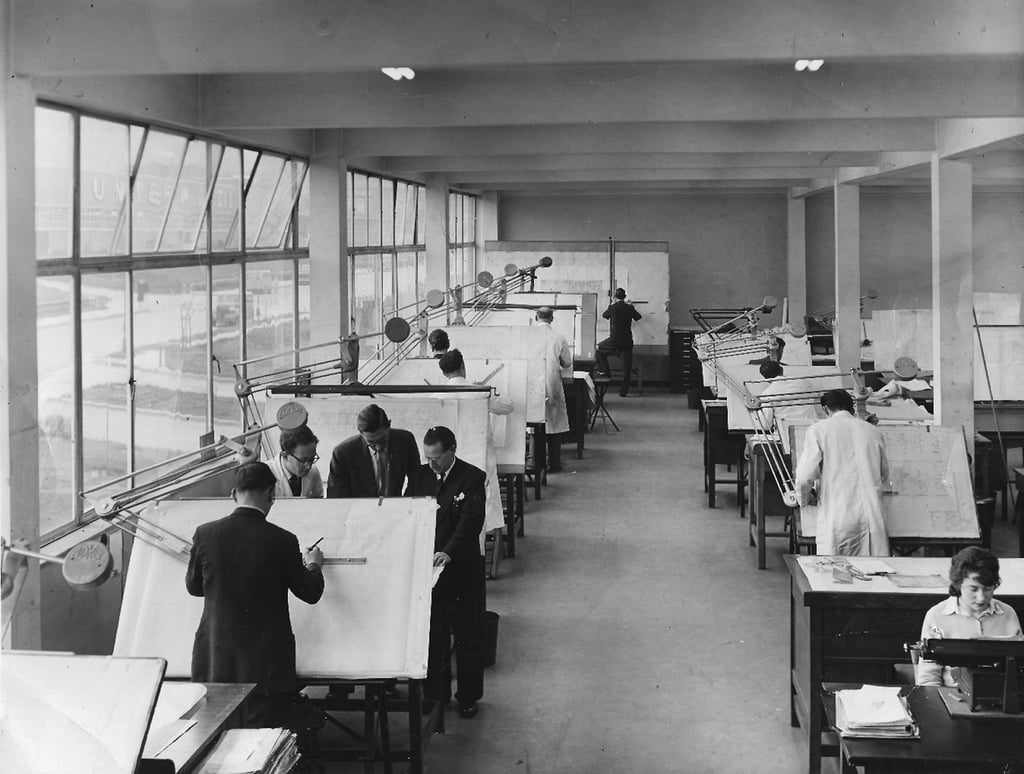
I was a very good draughtsman and thoroughly enjoyed quietly working at a drawing board all day, it was quite relaxing, especially after a weekend with little or no sleep, which was the norm for me at the time. I worked for a designer called John Bowyer, who was a great character with a deadpan sense of humour that resonated with me. We worked on various new projects, many of which were on behalf of overseas car manufacturers. John was sent to work in America for a while to work with Chrysler on a project derived from their 1960s ‘L Car’. It was quite unusual for someone to visit the USA in those days, so naturally we were keen to know what the States was like. I asked John how he’d found the experience, to which query he succinctly channelled Gladys Knight:
“LA proved too much for the man”
And left it at that.
The Chief Designer was a man called Jack Field. Jack was a bit of a minor legend in the automotive industry. When Alec Issigonis had been wrestling with the problem of how to put the engine in sideways for the Mini yet still connect it to the wheels, he came to see if Jack knew of a solution. Of course, Jack knew – he dug out some old designs from the 1930s for a device called a Rzeppa CV (constant velocity) joint which had been used on a few early European vehicles and said that he could easily adapt the Rzeppa to fit into the limited space available in a Mini. Hardy Spicer won the contract to produce the driveshafts for the Mini and the Rzeppa became the standard for front-wheel drive cars everywhere.
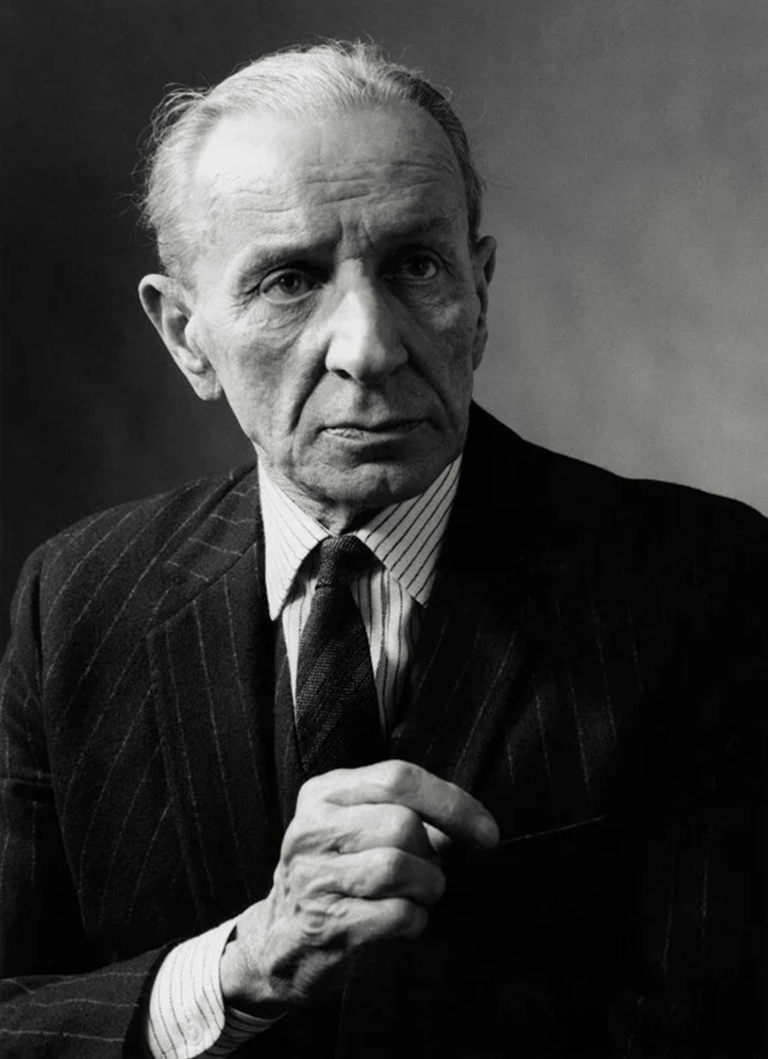

(Sir) Alec Issigonis. Genius car designer
Buoyed by the success of the Mini, British Leyland began to launch a range of front-wheel drive vehicles with drive shafts supplied by Hardy Spicer, but, to Jack’s chagrin, they insisted on simply upscaling the Mini design, rather than taking each design back to engineering first principles. Jack insisted that this strategy was doomed, because as the vehicles got bigger and more powerful, the metal in the CV joints wasn’t sufficiently robust to handle the extra torque. Things came to head with the Austin Princess, which suffered terribly from a syndrome called ‘knocking joint’ whereby the hard ball bearings in the joint dig into the softer metal casing which isn’t strong enough to take the load. This was precisely what Jack had laboriously calculated would happen, using pencil and paper.
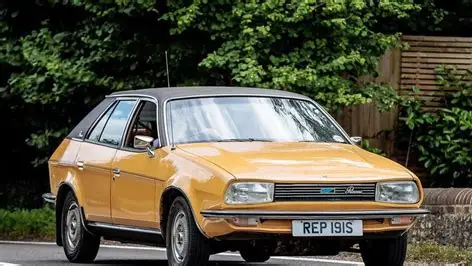
The catrophic Austin Princess (c) carandclassic.com
The Design Department had invested in a Hewlett-Packard 9810 programmable calculator, which was, in effect an early desktop computer. It was gathering dust in a corner because no-one knew how to work it, so Jack asked me if I could do anything with it. Working on the time-honoured principle of ‘when all else fails, read the manual’, I set about learning how to program the damned contraption. Eventually I was able to transpose all Jack’s pencil-and-paper formulae onto a deck of magnetic cards, which then made it possible for us to input the engine size, distance from the gearbox to the wheels etc, let the machine work through the stress and strain calculations and eventually come out with a recommendation for the size and strength of the CV joint required for any target vehicle. Jack was chuffed to bits because now he had irrefutable evidence to support everything he’d been saying to the people at Austin and Morris for the past ten years or so.
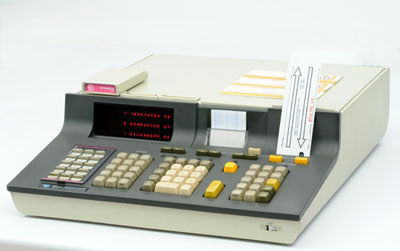
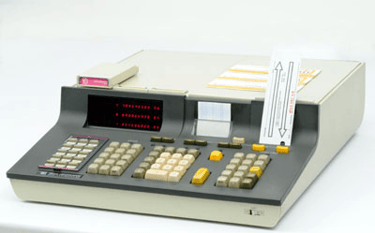
HP9810 - note the magnetic strips for storing programs
Look Out Girls, It’s Errol Flynn!
We used to draw on vellum, which is a semi-transparent material. You’d first of all do the outline of what you were drawing in pencil and then once it was OK, you’d go over it all in ink, making the lines permanent. This would then become a Master and would be stored in huge filing cabinets in a room called the Print Room. When someone needed a working copy of the drawing, the women in the Print Room would take the A0 or A1 sized vellum Master and run it through a huge device called a Diazo machine – the workhorse for drawings: they exposed the translucent Masters on top of light sensitive diazo‑coated paper, then developed the image using ammonia vapour under ultraviolet light, producing a readable white‑background plan on paper with brown or blue lines.
The women in the Print Room were a ribald mob. It seems that when you get a group of women working together, they are often worse than a group of men when it comes to vulgar banter. I found this out to my detriment on one unfortunate occasion:
It was a Monday afternoon, and I’d just finished a Master Drawing after three or four days’ work. I strolled into the Print Room to get the drawing catalogued and filed, only to find myself in the midst of what can only be likened to an audio version of a slightly saucy Berryl Cook painting:
“Uh oh! Look out girls – here comes Errol Flynn! Quick! Arses up the wall and keep your hand on your ha’penny! Whatever happens don’t bend over to pick up the soap. Keep your knees pressed tight together” and so it went on, for what seemed like an eternity.
It soon transpired what was the root of all this hilarity. One of my friends, Anna, was an apprentice stationed in the Print Room. Over the weekend, Anna and I had been involved in a bit of a drunken threesome – me, her and another girl. For some reason, God only knows why, Anna had elected to tell the women what had transpired, presumably, knowing her, going into no little detail. I was never allowed to live it down and from that day on could only enter the Print Room with a stomach-churning sense of dread anticipation.
A Bridge Too Far
After Design, the next port of call was the Laboratory. My brother had worked in the lab and a lot of the people in there remembered him quite fondly, so would always ask me how he was getting on and pass on their regards. The lab was an interesting place to work, employing a mix of metallurgy and chemistry. One of the regular jobs would be to prepare samples for mechanical testing and metallurgical inspection under a microscope. We’d take a component off the production line, section the test piece using an abrasive saw, mount it in plastic, grind and polish it, make it completely scratch-free with a mirrored surface, etch it with acid and dye, then put it under the microscope and measure the number of inclusions per square millimetre to ensure that the chemical/metallurgical composition of the metal was good enough to ensure that the component wouldn’t fracture under stress or strain.
There was an old chap called Jim who spent pretty much all day preparing samples in this way. Jim was deeply religious, although not the kind of person who’d want to ‘convert’ anyone. We all respected his beliefs and treated him with respect. At one time, we also had an apprentice called Tim working in the lab. Tim was a proper character, a bit of a likeable clown and quite noisy. He was preparing some samples and one of the occupational hazards that would sometimes happen would be that you’d grind off a little bit of your finger on the polishing machine. It hurt. Tim did this and loudly exclaimed:
“Oh Christ, I’ve cut my finger!”
Old Jim, quietly interjected:
“Please don’t take the Lord’s name in vain, Tim”
Tim: “No, sorry Jim, it won’t happen again”
Jim: “Thank you very much, I appreciate that”
About ten seconds later, Tim grinds his finger again:
“Jesus fuckin’ wept! I’ve done it again!
Old Jim just sighed and resigned himself to working with heathens.
One day old Jim came up to me and said, completely out of the blue:
“Would you like to come to a film premiere? I was in the Arnhem landings and they’re having a special showing of a new film about them called A Bridge Too Far at the Gaumont. My wife’s not interested in going, so I’ve got a spare ticket”
“Blimey, Jim, I’d be proud to come with you, but why are you asking me?”
“Well, I’ve got no kids, I don’t like my nephews and nieces much and you’re a good lad, so I thought you might be interested”
“Of course I am, when is it?”
So, Jim and I kicked along to the Gaumont cinema. I thought it was a good film, directed by Richard Attenborough, although as things turned out the critics didn’t rate it much. After the film there was a reception and buffet for the old paratroopers in the bar. I kept a respectful distance while Jim chatted with his old partners-in-arms, I stood in the corner having a quiet drink and nibbling sausage rolls. It was interesting watching all these old chaps standing there with their pints of bitter chatting quietly amongst themselves. I was watching them, thinking about the terrible things they must have seen and endured. They’d been unaware that a couple of crack Panzer Divisions were in place at Arnhem and were ill-equipped to tackle them, owing to a string of planning and logistical cock-ups. The Allies had suffered terrible casualties.
These were just a bunch of elderly men, quiet men, the kind you wouldn’t look at twice if you passed them in the street. They generally wore bifocal glasses, some had pullovers on, all had grey hair or were bald, they were men who’d normally be happiest on their allotments or down the pub playing dominos, just everyday people. I remember thinking that in their day these blokes must have been as hard as nails, proper tough bastards, paratroopers fearlessly dropping behind the German lines and then fighting heroically against superior forces. They’d absolutely wipe the floor with someone like me, or indeed most of my generation. They deserved to be treated with the utmost respect.
On the way home I asked Jim if the film had been realistic, had things really been as chaotic and ill-conceived as the story had made out? He confirmed that it had indeed been a shambles from beginning to end, but to his mind the real casualties had been the Dutch people. Hundreds had been killed in the Allied bombing and then after the battle, the Germans had treated them terribly. The two armies had chosen to be there; the civilians were simply caught in the middle.
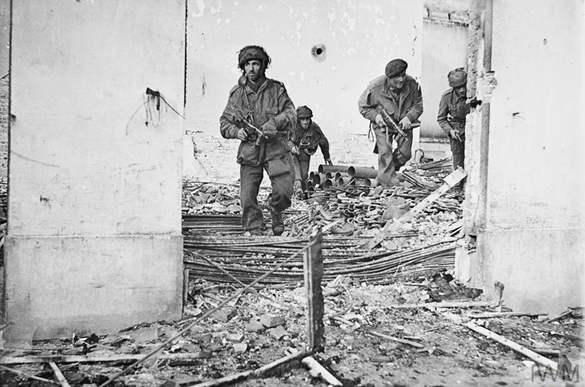
House-to-house fighting at Arnhem © iwm.org.uk
Well, this is going on a bit, isn’t it? When I set out on this, I’d anticipated that ‘Hardy Spicer’ would be just one article, but this is the second part, and I’ve still got a few more bits and pieces to share. I hope it isn’t TOO boring for you – is it? It would be great if you could let me know your thoughts via a brief note on the contact form below. Even better, you could buy me a coffee!