Career Choices
Like most kids, I didn’t really know what I wanted to do when I left school, although I had an inkling that I’d quite like to be a quantity surveyor (can’t remember why). In the final year at school, we were allowed time off to attend job interviews, so I applied for dozens of jobs, purely in order to be able to play school-endorsed truant. It quickly became apparent that quantity surveying would be out of the question, most of the jobs were effectively interns, extremely badly paid on the assumption that some kind of parental support would be forthcoming which, in my case, would be impossible, in fact I was expected to get to work as young as possible in order to help Mom out financially.
There was some kind of half-arsed careers advice available from school, which seemed to mainly consist of someone saying, “Have you considered a career in the Civil Service?”, which would be anathema to someone as ill-disciplined as my good self. I didn’t fancy working in an office.
Eventually, Doug (my sister’s father-in-law) suggested that I should have an interview for an apprenticeship at Hardy Spicer, where he was a foreman in the stores. He got me an application form and off I toddled, wearing the ill-fitting suit that we’d bought for my brother’s wedding a few years earlier, since which time I’d grown a couple of inches.
Hardy Spicer was a long-established manufacturer of auto transmission components, to be specific prop shafts for rear-wheel drive vehicles and constant velocity joints for front-wheel drive vehicles. They were pretty much the industry standard at the time and had become part of the GKN group of companies. The factory was in Erdington and employed about 3,000 people.
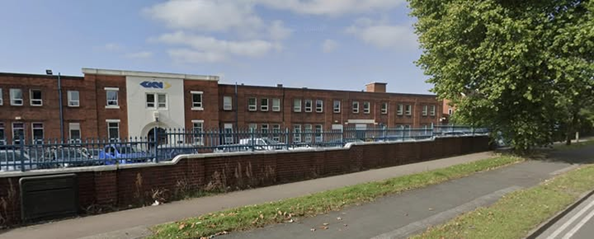
Hardy Spicer – the old Works. Copied From Facebook
The Interview
The day of the interviews was a bit of a non-event. There were several of us there. In the morning, we had to do some kind of intelligence test plus a factory tour, then we had lunch in the works canteen and during the afternoon were wheeled in one at a time for an interview with the training manager, John Jackson. My interview was a bit of a farce and lasted about 45 seconds – John told me I’d racked up the highest-ever score in the test and offered me an apprenticeship virtually as soon as I’d sat down. I never even got the seat warm before I was wheeled out and the next kid came in.
The offer of a Student Apprenticeship was contingent on my getting five ‘O’ Levels, including Maths and English, so I buckled down and started to do some revision, in fact it’s fair to say that I became obsessed with studying. I was due to sit eight ‘O’ Levels and the school was confident that if I pulled my finger out and took things seriously (for a change), I could pass five, although as a safety net they also entered me for CSE exams in Chemistry and Physics, in case I failed the ‘O’ Levels in those weaker subjects, so I was due to sit ten exams in all. I became a bit of a hermit, studying all day in the front room, accompanied by the sounds of The Who, Rolling Stones, Emerson Lake & Palmer, Frank Zappa and Captain Beefheart playing on the record player.
The Exam Results
After we’d sat the exams there was a several week hiatus before we were all called into school to get our results. It was good to see a lot of my schoolmates again and we sat on the floor in the corridor outside the headmaster's office, chatting and waiting our turn.
Eventually, I was called into the head’s office where Mr Shirley (Headmaster) and his two key sidekicks Mrs Boote and Mr Mills were waiting, poring over the results sheets. Having put so much work in, I was quietly confident that I’d got the five passes required by Hardy Spicer. Mr Shirley got straight to the point:
“Well, Carberry, it would appear you’ve finally done what we always felt you were capable of. You’ve passed all eight ‘O’ Levels and also achieved Grade One passes in the CSEs, so that adds up to ten ‘O’ Level equivalents. Well done. VERY well done!”
I quite literally nearly fainted, my legs went wobbly and I had to sit down for a while as they moved on to trying to persuade me to stay on for ‘A’ Levels. Although from a social point of view I would have liked to stick around for another two years in the sixth form with many of my good friends, staying on was never an option, owing to the financial situation at home and also, curiously, that I’d started to lose respect for some of the teachers,, who, compared to the adults I was mixing with outside of school, now seemed rather immature.
So I’d left school at 15, a few weeks before my 16th birthday
The Apprentice School
The first year of my apprenticeship was spent in the on-site apprentice school. The manager was a man called Les Butlin. I understand Les had formerly been a Naval Officer – he certainly liked everything in the school to be ship-shape. He used to have us scrubbing the parquet floors every Friday afternoon.
The apprentice school came as a culture shock to me, and I really didn’t like it. Waverley had been very relaxed and laissez-faire, but the school was highly disciplined, which I suppose makes sense when you thing we were operating machinery which could, if you were sloppy, be very dangerous. As I say, though, it really didn’t suit me, and I was quite unhappy there.
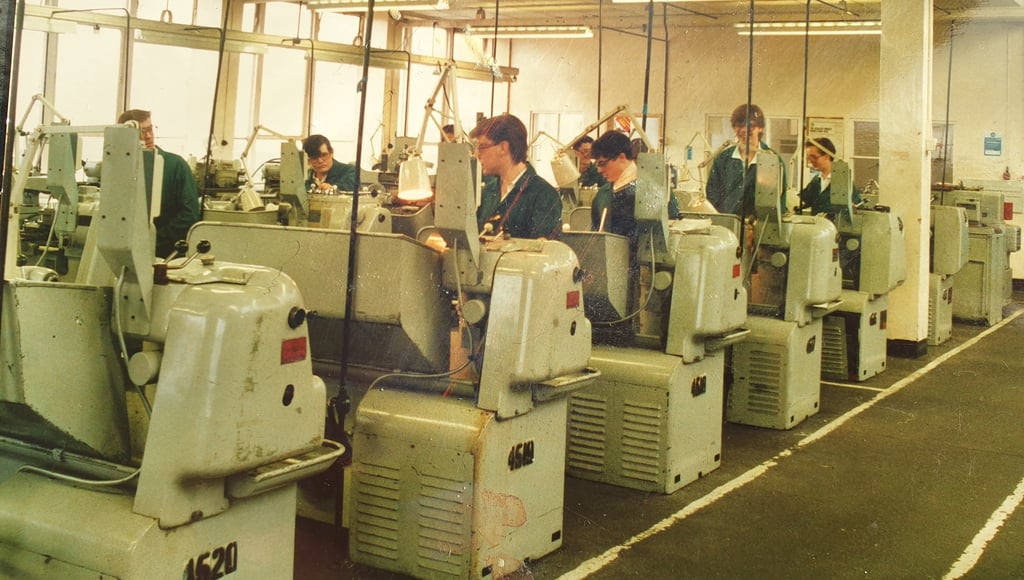
The Lathe Section in the apprentice school – where Tim developed ‘dosser's elbow’ (see below). Copied from Facebook
On the second or third day of my employment, I went to visit my granddad who by now lived in a council flat nearby in Erdington. He was interested to know how I was getting on:
“So, what’s work like?”
“Pretty crap, really, I don’t like it”
“Well, work’s like that. In my experience, the first forty years are the worst. After that, it’s plain sailing”
Which advice cheered me up no end.
Les’s Boat
Harking back to his Navy days, Les Butlin had us all building a great big wooden boat in one of the workshops. It had taken two or three years to construct and eventually the Great Day came. A crane was hired, big sliding doors were opened, we manhandled the boat outside on its rollers and the crane slung it across the road and into the Fazeley Canal which flowed alongside the apprentice school.
The crane gingerly lowered the craft into the canal, the straps were released and it promptly lurched to about a 45-degree angle before thankfully coming to rest before it had rolled over and capsized altogether. We’d got the ballast all wrong, which I suppose is what can happen when you have a few dozen teenage apprentices trying to do a skilled shipwright’s job.
Les began to recruit volunteers to go onboard the wretched thing and move the ballast about, but very few people were keen on the idea, it looked precarious enough as it was, without anyone on board, moving around. Eventually, though, they got it onto an even keel. I’m not sure whether it actually sailed anywhere – I really hope it didn’t. The canal was blocked for a couple of weeks, which didn’t go down very well with British Waterways.
Speaking of the canal, something else springs to mind. Further along the canal, heading in towards Birmingham, it passed close to Fort Dunlop. We were all lounging around in the sun one lunchtime when a barge came past, towing a line of big bales of natural rubber, destined to become car tyres. There must have been about twenty of these bales floating along in the wake of the boat. I assume this must have some kind of trial to see if this was a cheaper way of getting the rubber from the Liverpool docks to Birmingham and I wondered how they managed when they came to a lock, of which there are many on the canal system. They must have had to uncouple the bales from the boat and pull them through the lock by hand. It can’t have been very efficient and we only ever saw it the once. Hardy Spicer used the canal a lot to bring in boatloads of forgings and had a gantry crane over the canal adjacent to the Raw Material Stores at the bottom of the site.
Another canal tale: The factory had a volunteer fire brigade. Apprentices were ‘encouraged’ to volunteer, so we obeyed. One of the things we had to every couple of weeks was practice running out the fire hose from the fire engine. They used to time us to see how we were performing, it was just a dry run and more often than not a gaggle of blokes from the factory would stand and watch us, jeering and taking the piss. On one occasion, however, and unbeknown to the blokes, we were doing a wet run, so had put an inlet pipe into the canal and filled the fire engine’s water tank. We did the run, they took the piss, we opened up the hose, and they were suddenly hit by a jet of high pressure canal water. People were being knocked down, slipping over and getting soaked to the skin. They stumbled around a corner, out of the line of fire, only for us to point the hose over the top of the building they were hiding behind and soaking them all over again! It was truly epic, like something from a Laurel and Hardy movie!
Dosser’s Elbow
There was an apprentice called Tim, who was a bit of an amiable buffoon, a lanky, thin lad with a shock of thick black hair. It was impossible not to like him. One day, we were on the lathes, cutting screw threads, and Tim was idly leaning on the headstock of his lathe. The vibrations from the gearbox must have done something to his elbow which caused it to seize up, his arm was completely locked in a a bent position. Startling us all, Tim suddenly shrieked:
“Aaaaarghhh! I’ve got dosser’s elbow!”
Another time, they sat us all down in a darkened classroom and made us watch safety videos. The idea was to really drive home the message that a factory can be a very dangerous place. We nearly all had long hair, so they showed us videos of people not wearing hairnets who’d got their hair tangled up in rotating machinery and been scalped as a result, along with close-up videos of people having shards of metal removed from their eyeballs after operating a machine without wearing eye protection. I was sitting close to the front and could hear the clunk of people in the darkness behind me falling off their chairs as they fainted. As a grand finale, they gave us a lecture on the evils of smoking which culminated in them producing a real lung clogged up with tar and stinking of smoke.
He’d survived the videos, but the sight of the lung proved too much for Tim, he had to go outside for a cigarette to calm his nerves.
Making stuff
We used to have to make a series of standard products which were marked in accordance with the standards of the Engineering Industry Training Board. We had to make some pliers, a mole wrench, a pair of little stepped blocks that had to fit together in a sort of mirror image of one another and lots of other stuff which I forget. I was crap at all of it – my workmanship was very shoddy and slapdash, mainly due to my inherent lack of concentration and poor attention to detail. I wasn’t alone in this respect, though, several of the other lads were just as bad, however I noticed that I was always singled out for particularly harsh criticism and my marks were appreciably lower than everyone else, then, at the end of the year, it became clear why…
There were two intakes at the school; 16-year-olds like me and 18-year-olds who were heading to university. Because I looked and acted older than I was, the instructors had assumed I was one of the 18-year-olds and had marked me in accordance with the standard expected of them, rather than my own age group. They apologised for having made my life a misery.
Ted and Roger
Once I’d escaped from the confines of the apprentice school and moved out into the factory proper, I began to enjoy work a lot more. They used to move us around the various production lines, doing on-the-job training and getting given various semi-skilled tasks to perform. I got on really well with nearly everyone I worked with (I’m a sociable little soul) and generally had a lot of fun. On the machining lines, they’d normally pair us up with the Setters, the men who would change the set-ups of the machines between production runs of different components. Two particular setters come to mind – Ted and Roger. They were inveterate piss-takers, both had been in the Army and would tear into my appearance (shoulder-length frizzy hair and wire rimmed glasses) with friendly relish:
“Jesus! Look at the fuckin’ state of you, you cunt! What DO you think you look like? When we were your age, we were bollock-deep in muck and bullets, but all you have to worry about is where the next shag’s coming from. You don’t know you’re born!”
WARNING: Some people may find the next part even more offensive than the last bit, for which I apologise. Please bear in mind that this was the early 1970s and cultural sensitivities were different back then:
We had a machine operator on the line called Sid. Sid was a big black man, from Trinidad if I remember correctly. In the course of their routine day’s piss-taking Ted and Roger would taunt Sid.
“Fuck me, Sid! You look like a fuckin’ gorilla, looming over that machine. Were you in Planet of the Apes, mate?” and so on. He’d always give back as good as he got, although I would imagine he found it all insulting and unnecessary.
One day, Sid turned up 06:30 for the morning shift as per usual, but he was visibly upset. It transpired that someone had daubed racial abuse on his front door and thrown a brick through his window during the night. He was worried about his wife, alone at home.
I rolled in at 08:30. Ted and Roger asked me if I could help the foreman hold the fort for a few hours and got themselves (unpaid) pass outs then disappeared. They reappeared in the afternoon. They didn’t say where they’d been. The following morning, Sid turned up and burst into tears – Ted and Roger had gone around to his house, replaced the broken pane of glass, repainted the front door and bay window, then left after giving his wife some flowers and chocolates. Sid was overwhelmed with gratitude, but the piss-taking just resumed as per normal. Sid wouldn’t have expected anything less.
I said to Ted and Roger that it was really nice what they’d done. They swatted the compliment aside, simply replying “Well Sid’s our mate, isn’t he? No-one, absolutely no-one fucks around with one of our mates like that, the bastards”.
Many of the machines at Hardy Spicer were worn out and badly needed replacing. A good friend of mine, Ginger Bob, was working on a machine that had been in use since 1906. It was this lack of investment that was slowly killing British Industry. Setting the machines up to work properly was a bit of a black art. One time, I was trying to get a turret lathe set up to machine components to within a couple of thousands of an inch, but the turret was worn out and impossible to adjust accurately, Ted was supervising me. I ran a couple of test pieces, but one was too big, the next was too small. This knackered old machine required some fine adjustment of which it was incapable. Ted passed me a copper hammer:
“Here, use this. Give it a pisser with the hammer, about…. There”
I duly gave it a pisser with the hammer. The next piece was close, but still not right. Ted gave the hammer back:
“Should I give it another pisser, Ted?”
“No, about half a pisser, maybe three quarters at most”
Eventually we got the machine producing within the tight tolerance, which, as I say was a couple of thousands of an inch.
While we in Britain were belting the crap out of these ancient, semi-derelict machines with copper hammers to try and get them to work properly, our Japanese competitors were investing in sophisticated computer-controlled machines, getting themselves ready to wipe us out. Still, at least we were keeping a small army of GKN accountants happy, so that was something.
Pinocchio


(c)ar.inspired.com
There would often be long periods of time to kill in between setting up machines for a new production run, and, as we all know, the Devil finds work for idle hands. In this instance, the possessor of the idle hands, which would be me, elected to entertain the blokes and women on the machines. I went down to the laboratory and purloined a large cardboard test tube sheath, it was about nine inches long. I dyed the sheath bright red, stuck it to my nose with plasticine and went dancing like a marionette down the gangway, singing the Pinocchio song:
“..I've got no strings to hold me down
To make me fret, or make me frown
I once had strings, but now I'm free
There are no strings on me..”
The machine operators loved it, they accompanied my singing by banging rhythmically on their machines with spanners and shouting “Oi, Oi, Oi!”
About an hour later I was summoned to the Training Manager John Jackson’s office for a bollocking:
“You’re supposed to be one of the people in line for a management position in this business and you go around acting like a bloody clown. How can you ever expect anyone treat you with respect when you behave like this, you bloody idiot. Now GET OUT”
Condoms and Tights etc.
One of the blokes in the factory had a warehouse card, so used to stock up on things like condoms and tights. He’d get me to wander around the factory with a cardboard box full of contraband, fulfilling the orders he’d taken. There was one part of the factory which was incredibly noisy with centreless grinding machines fed by vibrating hoppers full of small components that rattled around and made a terrible racket. You had to wear ear protectors if you were working there. Several of his regular customers were employed on this line so I’d pop my earplugs in and make myself visible. The chaps on the line had to adopt the medium of mime in order to let me know what they wanted. I shall never be able to erase the visual image of a 16-stone bearded worker in stained, oily overalls miming in a rather slinky manner that he was slipping on a pair of tights, or, even worse, a condom.
On one occasion, someone ‘somehow obtained’ a load of LP records, which I help him to sell, buying a few for myself. There some real belters amongst them – Parallel Lines by Blondie, My Aim is True by Elvis Costello, All Mod Cons by the Jam, ‘Live’ by Bob Marley, New Boots and Panties by Ian Dury and the Blockheads. I only paid about £1.25 for each of them, brand new.
Heat Treatment Department
All of the stuff we made had to be heat treated in order to harden the steel. The way everything was made would be (1) come in as forgings from another GKN company, (2) soft machining on lathes, drills milling machines etc. (3) heat treatment, which involved putting the machined components into furnaces. (4) Quenching the components in oil to help balance the hardness and toughness of the metal, (5) Sending the now-hardened components off for grinding.
I really liked the Heat Treatment department, it was a cavernous great hall, like something out of Dante’s Inferno – red hot furnaces being opened and closed, smelly hot oil smoke lingering in the air and noisy, with the sound of gas burners roaring away. The blokes in the department were quite a tough bunch, they’d often work stripped to the waist because of the heat, and would get filthy in the course of the day.
One of the men in there had a very physical job, in the course of a shift he would have to shovel literally tons of components into the open mouth of a roaring furnace for eight hours a day, shovel them out again after a couple of hours and plop them into a smoking oil bath. The mouths of the four furnaces he operated were slightly above head height, so he’d be effectively weight training all day long. He had tremendous upper body strength and not an ounce of fat on him. There was an incident when his teenage son had been beaten up in a pub. He knew who’d done it (they didn’t know him), so he followed them into the toilets of the pub and, as they were having a wee in the urinals, he grabbed the back of both their heads and, using all his considerable strength, smashed their faces into the wall, fracturing their skulls.
There would usually be three apprentices in Heat Treatment at any one time. The components used to come and go in steel stillages which were moved around on electric pallet trucks and, as I mentioned it was a very big hall, so quite naturally we apprentices concocted a race track and would sit on top of empty pallet trucks, pushing the handle forward and hurtling around. There would often be oil spillages on the floor, so the trucks would skid all over the place. The blokes would place bets on us.
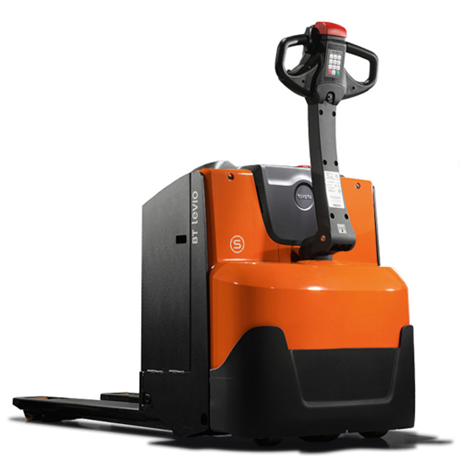
Electric powered pallet truck © Toyota-forklifts.ie
The Great Broach Incident
There’s an operation in Manufacturing called broaching. We used broaching machines for producing the internal splines on the sleeves of a propshaft joint, it was the way the length of the shaft could be adjusted to adapt to variations in the distance between the gearbox and the rear differential.
A broach is rather like a long gently tapered cheese grater, with circles of teeth, each tooth a few thousands of an inch longer than the one preceding it. The broach tool would be slowly dragged through the centre of the sleeve by a powerful hydraulic motor. The sleeve would be clamped in a fixture. One day, the setter I was working with cleared off somewhere and left me to set up the broaching machine. I’d done this job before.
I must have put the sleeve into the fixture at a bit of an angle because when I pressed the button on the hydraulic machine, there was an almighty bang and the broach tool snapped clean in half. This was a tool about two inches in diameter, made of extremely hard steel, so you can imagine how loud the bang was! Undismayed, I got another broach tool and put it in. Big bang, same result. By the time the foreman got to me, I’d snapped three broach tools – he was absolutely furious, not just with me, but with the setter who’d buggered off somewhere and left me unsupervised.
I was informed, in no uncertain terms, that each of those broach tools had cost the equivalent of a year’s wages for an apprentice. I wasn’t popular.
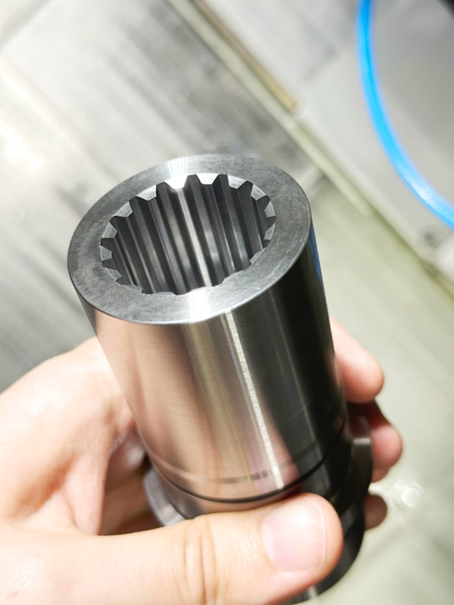
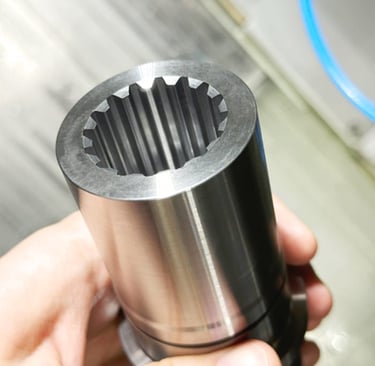
A broached internal spline © Gisstec.com
He Fell off the Back of a Bus
I once fell off the back of an open-backed No.28 corporation bus as it approached the factory. I slid for about twenty yards on my hands and knees, cutting my hands to ribbons. I clocked in, dripping blood all over the machine and everyone else’s clock cards then made my way to the small hospital we had on site. They picked the gravel out of my hands and then stitched up and bandaged the wounds. Obviously, I couldn’t work in the factory with bandaged hands so, for a couple of weeks, I worked in the weighbridge office, weighing the trucks in and out and producing the requisite paperwork for the drivers. It wasn’t particularly inspiring, so I elected to see if I could pull together an imperial ton of apprentices and produce the paperwork to prove it. We succeeded, but I wasn’t popular because I’d interrupted a Thursday afternoon apprentices’ poker school. We were always paid on a Thursday lunchtime and many’s the time I saw an apprentice lose a whole week’s wages in a single hand of poker.
So, a few lowlights from my early days as an apprentice. I hope you liked it. I’ll be revisiting Hardy Spicer for more stories in the near future. In the meantime, if you enjoyed this, why not buy me a coffee for a couple of quid? Just click on the link: