El Alamein
Up until 1942, the Nazis had had everything pretty much their own way in World War Two. The Battle of Britain in 1940 had been a setback for Hitler, but there had been great successes elsewhere. The Battle of El Alamein offered Britain a chance to go on the offensive, but only if the conditions were right and the odds were stacked in Britain’s favour.
General Montgomery realised well before El Alamein that this was going to be a major tank battle, fought more like a Victorian cavalry battle than the grinding infantry battles that had characterised the 20th Century so far. At the start of the battle, the Germans had two types of Panzer tank available, both heavily armoured and upgraded with longer range guns that the British Churchill, Valentine and Crusader vehicles. Montgomery knew the British were outgunned, so persuaded the Government to use the Lend-Lease Deal that had been set up in 1941 with the Americans and acquire some Sherman and Grant tanks, in fact it’s said he insisted on this before beginning to plan the battle – using the available weaponry, the British tanks wouldn’t be able to get close enough to the Panzers to be able to engage them. The government agreed and bought three hundred Shermans which were shipped to Britain, dodging the U-boat patrols whilst in transit.
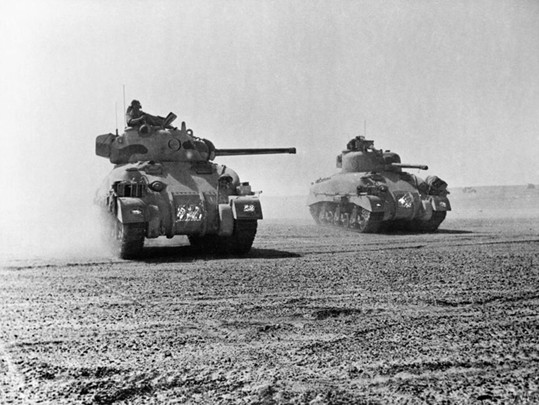
Sherman tanks kicking up sand at El Alamein ©HistoryDefined.net
This was to be the first tank battle in history to be fought under desert conditions and it was quickly recognised that the combination of sand and heat was presenting a major problem – the Sherman had an air-cooled radial engine and keeping the engines cool enough to be able to keep running without sucking too much sand into the air intakes was a headache. The Germans, with typical engineering thoroughness, had developed a very effective multi-stage filtration system incorporating oil-soaked pads to ‘grab’ the sand particles. The British tanks relied on a system of deflectors for the Sherman’s engine that would require daily servicing and cleaning by brave maintenance teams, often working within a couple of hundred yards of the frontline.
Eventually, the sand would block the air ducts and the engine would overheat. Luckily for Montgomery, help was at hand – The Head of Engineering at Loughborough Technical Institute was John Frederick Peck, a brilliant and ingenious thermodynamicist. The War Office commissioned Peck to dream up a way by which massive volumes of cooling air could be sucked in to the engine whilst the sand would be removed and blown out. Peck got to work, built a few prototypes and within a matter of weeks the Sherman tanks were being secretly retrofitted with his centrifugal air flow system.
The battle continued. The Shermans’ guns lacked the range of the Panzers but they boasted superior speed. They were able to get in close, rather like a boxer in the ring, strike and then swiftly retreat. The Panzers would give pursuit but all too often their cooling systems would fail and the engines seize up. RAF fighter bombers from the Desert Airforce Squadron were than able to attack the defenceless Panzers at will, bomb them and set them alight, cooking the crew alive. The British tank crews grimly referred to this as ‘having a brew-up’.
Peck’s invention wasn’t perfect and his system required field modifications in the heat of battle, but nevertheless it helped enormously in combatting the superior engineering of the Panzers and was much better than anything the British Crusader and Matilda tanks had available.
J.F Peck’s thermodynamic trickery had made it possible for General Montgomery to fight the battle as he’d hoped, with his crews operating in the manner of a light cavalry regiment. It was a huge success and the first major turning point in the course of World War Two.
After the War, Churchill wrote to Peck. I don’t know where the letter is now; but to paraphrase it, it said something along the lines of “without El Alamein we may not have won the War and without your contribution we could not have won El Alamein”.
In 1966, Loughborough College of Technology became a University specialising in Engineering and (the by now) Emeritus Professor J.F. Peck’s collection of papers dating from 1915 to the 1960s was incorporated into the University’s library. Professor John Frederick Peck died in 1971, aged 74.
He was my wife’s grandfather.
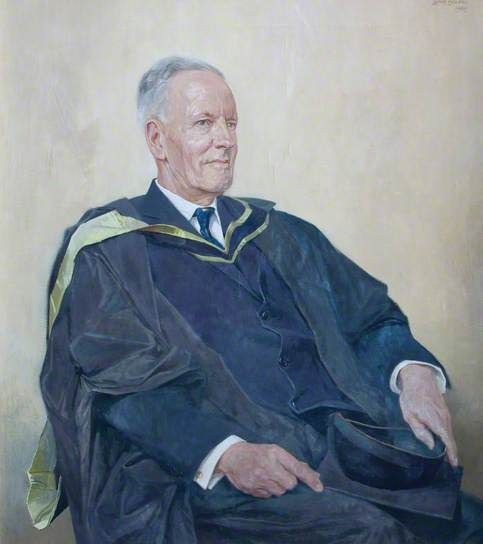
Professor J.F.Peck courtesy Loughborough University Library
I hope this was interesting. It's astonishing to think how many untold stories there must be about the Second World War, isn't it? If you enjoyed it, why not buy my wife a coffee in memory of her granddad?